
It is said by scholars that in medieval time, food hanging for trees was only for rich, noble people, the ones considered to be “high class” and consequently “high spirit. And that food in the ground was only for “low” class (low spirit) people. (Cfr. Massimo Montanari). The example that is usually brought to illustrate this statement, is that pears were only for riches, and onions only for poor.

It might be true according to philosophers of the time, or theologis, and for sure it is true that food was highly symbolic.
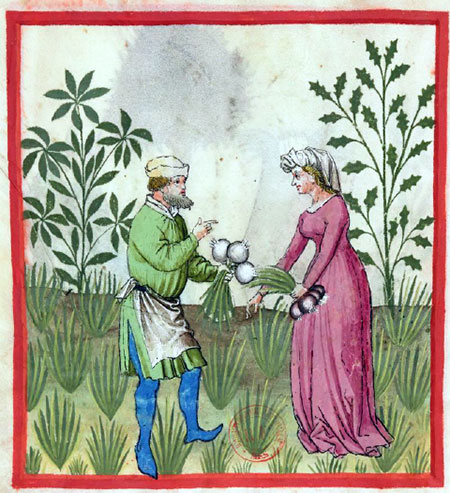
Yet, recipe books of the time are full of examples of “high food” and “low food” mixed together. In many aspects of medieval life there is a broad difference between the world that was described by a very few intellectual, often mimicking classical writers ad what was actually done.

In particular, I propose this recipe that we find both in Anonimo Meridionale and Liber the Coquina. The two books were written for the court of Federico II and Roberto d’Angio’. Nobody more “noble” than them lived in Italy in the entire middle age. Yet, they are served this soup, where pears and onions are tangled up in a delicious mixture, a very medieval taste.
A few things to be noticed: the double cooking (pears are boiled and then sauted); the abundant use of spices and saffron.
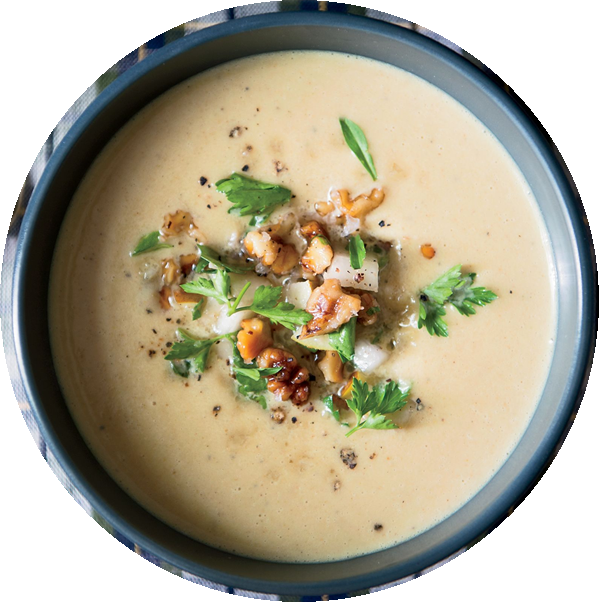
NOTE: This recipe is open to many interpretation. I cooked a light onion soup (onions are sliced into small pieces and very slow cooked untill transparent, then water is added), processed, colored with saffron, enriched with little cubes of pears and almonds and seasoned with salt and pepper but you can interpret the recipe below and enjoy at your taste!

And remember, while you are eating it: you are “breaking” the (supposed) rule that pears are only for high people with “high” spiritual feelings and onion is only for low people with low, hearthy feelings. Basically eating this soup you become more human!
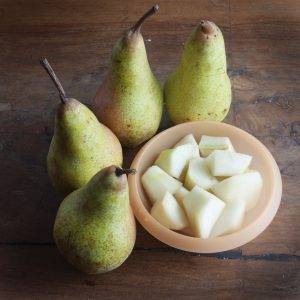
TRANSLATION Take fresh pears, and soak them in water; throw that water away, put them to boil in another water, with salt and oil and a little onion. Then drain them and put them to fry with spices and saffron in a little water and let them cook. And when they are cooked, serve them in bowls with a little spice.
And similarly you can use a little almond milk, without oil and onions, with a little sugar and a little salt.
De le pere. Rubrica .viij. [n° 21]
Togli pere fresche, e metille in acqua a mollare; e, gittata quella acqua, polle a bullire in altra acqua, con sale e oglio e poca cipolla, a sofriggere con spetie e çaffarano in poca acqua; e pone a cocere. E quando saranno cotte, menestra un pocho di spetie in scutelle. E similimente puoi fare in pocho di lacte d’amandole, sença oglio e sença cipolle, ponendo un poco di çuccaro e un poco di sale.
 Storia e storie in cucina